Digital waste tracking: What changes from October 2026?
16 September 2026 by CSG
Waste paperwork has never been the most exciting part of running a business.
Unfortunately, that has never made it optional.
From 1 October 2026, the way parts of the UK waste sector record waste movements will begin to change. Permitted waste receiving sites in England and Wales will be legally required to use the Government’s new digital waste tracking service.
This is the first phase of a wider rollout, rather than an overnight switch for every organisation handling waste. Here is what businesses need to know.
What is digital waste tracking and why is it being introduced?
Digital waste tracking is a new UK wide system being developed by Defra alongside the governments and environmental regulators of Scotland, Wales and Northern Ireland.
Its aim is to create consistent records showing what waste was produced, who transported it and where it was received.
Currently, information about waste movements is held across a mixture of paper based records and separate digital systems. That can make it difficult to build a complete picture of what happens after waste leaves the organisation that produced it.
Most businesses handle their waste responsibly. Unfortunately, some do not.
The Government estimates that waste crime and poorly performing waste sites cost the UK economy around £1 billion every year. Illegal waste sites, fly tipping and deliberately misdescribed waste can damage the environment, affect communities and place legitimate waste businesses at a disadvantage.
Mandatory digital waste tracking should make suspicious activity easier to identify. Regulators will be better able to check whether waste reached an authorised site and whether facilities are operating within their permits.
In short, it should become easier to follow the waste and harder to lose track of it when the paperwork becomes inconvenient.
You can watch this video for a quick introduction:
Who must comply and when?
The first phase focuses on organisations licensed or permitted to receive controlled waste. This includes most household, commercial and industrial waste.
From 1 October 2026, permitted waste receiving sites in England and Wales must record every load of controlled waste they receive through the Government’s Report Receipt of Waste service. This applies to permitted operations, installations and mobile plants. It can also apply to a permitted facility located on the site where the waste was produced.
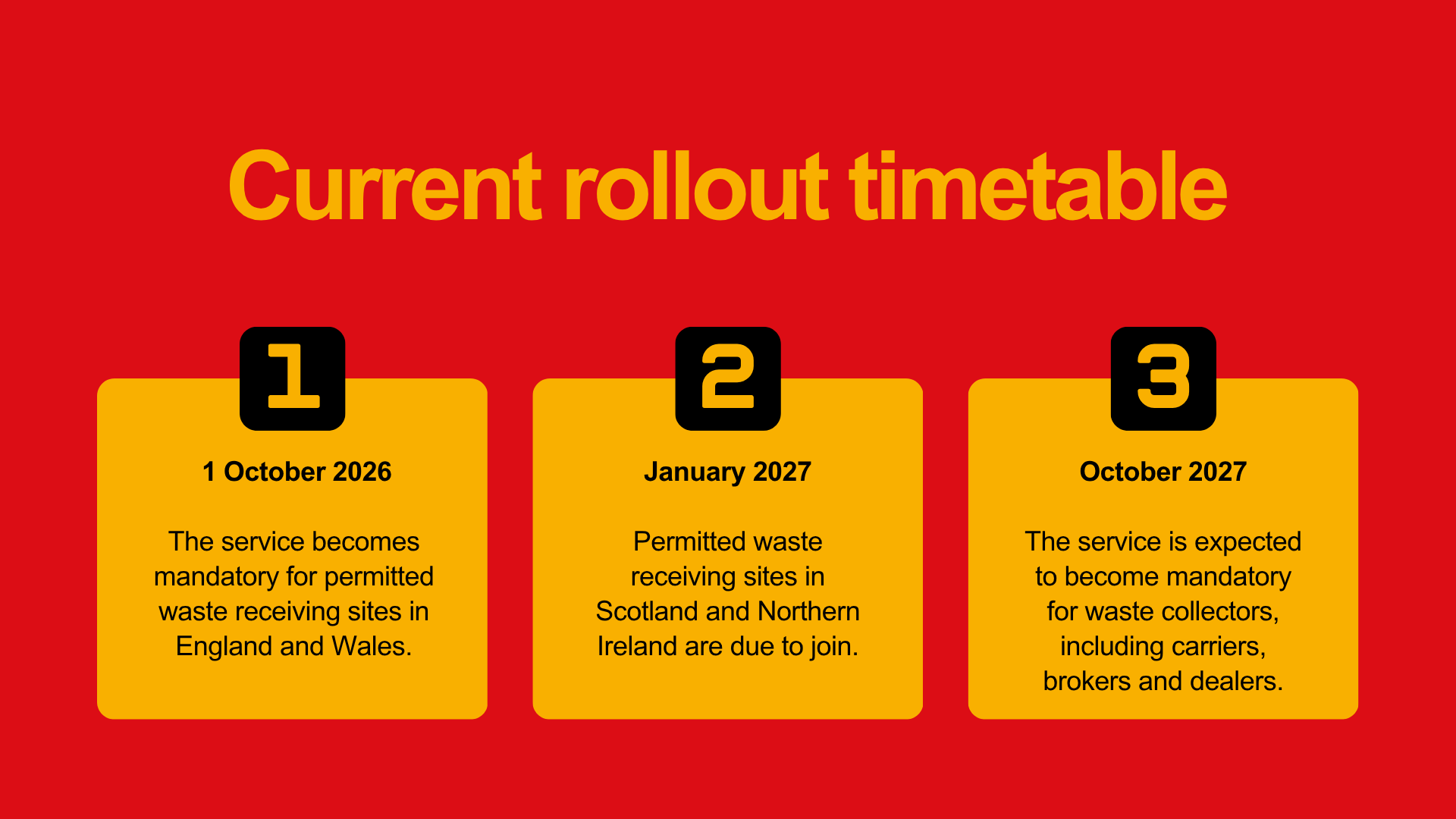
The current rollout timetable is:
- 1 October 2026: The service becomes mandatory for permitted waste receiving sites in England and Wales.
- January 2027: Permitted waste receiving sites in Scotland and Northern Ireland are due to join.
- October 2027: The service is expected to become mandatory for waste collectors, including carriers, brokers and dealers.
Waste sites operating under registered exemptions are not included in Phase 1 and are expected to enter the system later.
Different rules apply to household waste recycling centres. In England, permitted recycling centres must report commercial waste they receive, but not household waste brought in by residents. Household waste recycling centres in Wales are outside the scope of Phase 1.
Most waste producing businesses will not have to upload records in October 2026 unless they also operate a permitted receiving site. However, they must still describe waste accurately, use registered carriers and ensure it goes to an authorised facility.
Waste sites operating under registered exemptions are not included in Phase 1 and are expected to enter the system later.
Different rules apply to household waste recycling centres. In England, permitted recycling centres must report commercial waste they receive, but not household waste brought in by residents. Household waste recycling centres in Wales are outside the scope of Phase 1.
Most waste producing businesses will not have to upload records in October 2026 unless they also operate a permitted receiving site. However, they must still describe waste accurately, use registered carriers and ensure it goes to an authorised facility.
How will digital waste tracking work?
Every time a permitted site receives controlled waste, the receiver will need to create a digital waste record.
The record must be submitted within two working days, beginning on the day after the waste is received. Waste received on a Monday, for example, would normally need to be recorded and accepted by the system no later than 11.59pm on Wednesday, excluding bank holidays.
Although the receiving site submits the report during Phase 1, it can only record the information it has been given. Accurate digital waste tracking therefore begins with the business that produced the waste.
Required information can include:
- The producer’s name and waste collection address.
- An accurate waste description and European Waste Catalogue code.
- The composition and physical form of the waste.
- Its quantity and the type of containers used.
- Details of the carrier and receiving site.
- The relevant recovery or disposal code.
- Hazardous properties and components, where applicable.
- Persistent organic pollutant information, where applicable.
- The correct waste transfer or consignment documentation.
In other words, “three drums of unknown liquid from behind the warehouse” is unlikely to be enough.
If waste has changed since it was assessed or described, sites must be informed before collection or delivery. Incorrect information could delay acceptance or mean the waste cannot legally be received or treated at the intended facility.
This is particularly important for businesses producing hazardous waste, where its properties and composition may determine the appropriate treatment route.
Waste receivers will have two main ways to submit their information.
The preferred method is compatible waste management software connected to Defra’s application programming interface, or API. This allows software to exchange information securely with the Government service.
Organisations without compatible software can use Defra’s standard spreadsheet template. This temporary option is expected to remain available until at least October 2027. Businesses must use the supplied template rather than one of their own design.
Based on the current published information, access to the service will cost £26 per year for each registered legal entity rather than for every individual site it operates. Businesses should check the latest Government guidance before registering, as service arrangements may be updated ahead of implementation.
Are waste transfer notes being replaced?
No – not during phase 1.
The digital waste tracking requirement will initially operate alongside existing waste documentation and regulatory returns. It does not remove existing documentation responsibilities from October 2026.
Businesses must continue completing waste transfer notes, hazardous waste consignment notes and Annex VII documents where required. Permitted sites must also continue submitting waste returns and hazardous waste consignee returns in line with their existing responsibilities.
For permitted waste receivers, Phase 1 introduces an additional reporting requirement. Existing paperwork and reporting processes must continue unless and until the relevant government or environmental regulator formally confirms otherwise.
Until further guidance is published, businesses should not stop or change their existing waste documentation processes.
What should businesses do before October 2026?
Organisations operating permitted waste receiving sites in England or Wales should already be preparing.
Waste receivers should:
- Confirm which facilities and waste movements fall within Phase 1.
- Register for the Report Receipt of Waste service.
- Check whether their software can connect to the Defra API.
- Make sure all required waste information is being captured.
- Train employees responsible for accepting waste and submitting records.
- Establish processes for correcting errors and meeting the two-working-day deadline.
Waste producers should check that descriptions, classification codes and collection addresses are correct. They should tell their contractor if waste has changed in composition, quantity or physical form since it was assessed.
Finding out that a container does not hold what everyone thought it did is best done before it reaches the receiving facility.
Businesses should continue checking that their waste transfer and consignment notes are accurate. Those working with several suppliers or waste streams may also benefit from a total waste management service, bringing their collections, waste information and compliance records together.
Digital tracking should improve visibility, but it cannot correct inaccurate information at the press of a button. If the details supplied at the start are wrong, the resulting digital record may be wrong too.
How will CSG support customers?
CSG has a defined implementation plan in place to prepare our permitted treatment facilities, people and systems for the October 2026 requirements. This includes reviewing the information captured during pre-acceptance and receipt, and developing our longer-term system integration with the Government service.
Our technical and operational teams are reviewing the requirements against CSG’s existing pre acceptance, collection and site receipt processes. Employees responsible for accepting waste, checking documentation and submitting records will receive appropriate guidance and training before the new requirements take effect.
Customers may notice our teams asking for more detailed information or clarification during pre-acceptance. This is to help ensure that waste is correctly described and classified, suitable for the intended facility and supported by the information needed to create an accurate digital record.
Where information is missing or inconsistent, we will work with the customer to resolve it before collection or delivery wherever possible. Providing accurate information at the outset will help reduce avoidable queries and delays and ensure waste is directed to a facility authorised and technically able to receive and treat it.
Digital waste tracking will bring greater visibility and consistency to the waste industry. However, the foundations of compliant waste management remain the same. understand the waste, classify and describe it accurately, use authorised organisations and ensure it follows an appropriate and permitted route.
CSG will continue monitoring guidance issued by Defra and the environmental regulators and will update its processes and customer communications where requirements are clarified or changed before implementation.
Further information is available through the Government’s digital waste tracking guidance.
If you have questions about an upcoming collection, the information needed to describe your waste or how the changes may affect your business, please speak to your usual CSG contact or contact our team.