
Who are they?
Established in 1947, Twickenham Plating Group is a specialist technical plating company with a long history of supporting leading engineering businesses and equipment manufacturers.
Headquartered in Twickenham, the company’s production facilities are based at Pender Works in Poole, Dorset. Twickenham Plating Group provides a comprehensive range of plating services for customers across the UK and around the world.
Their work supports industries including electronics, aerospace, automotive and defence. Components plated by Twickenham Plating Group are used in everyday electronics as well as specialist applications where quality and precision are essential, from underground and subsea environments to aerospace and space applications.
CSG has worked with Twickenham Plating Group for over 15 years, providing hazardous waste removal services to support the safe and compliant operation of their site.
What were their challenges?
In Spring 2025, Twickenham Plating Group asked CSG to support a major decommissioning project at their site in Poole.
The project involved the safe decommissioning and removal of a large, ageing settlement tower that had been used to hold and settle treated wastewater from the electroplating process. The tower allowed heavy sediments to settle before treated water was released to the public sewer.
The structure was approximately 60 years old, around 9 metres high and 5.5 metres in diameter. Over time, a significant quantity of hardened metal hydroxide sludge had built up inside the tower, which needed to be safely removed before the structure could be dismantled.
The project presented several challenges:
- The working area around the tower was extremely tight
- Twickenham Plating Group’s production needed to continue throughout the works
- Traffic management had to be carefully planned to avoid disruption to neighbouring businesses
- Hazardous waste needed to be removed and disposed of compliantly
- The tank had to be cleaned and certified safe before structural dismantling could begin
Due to the limited access around the tower, lifting equipment and vehicles could not simply be positioned directly beside the structure. CSG therefore needed to develop a carefully phased plan that would allow the project to be completed safely, efficiently and with minimal impact on the customer’s day-to-day operations.
How did CSG make a difference for Twickenham Plating Group?
CSG created a phased programme of works designed around the customer’s operational needs. As part of the planning stage, Sharon Thomas, Regional Waste Solutions Manager for CSG’s Southern team visited the site to meet with Twickenham Plating Group, assess the access restrictions and discuss the most practical solution.
This hands-on approach is an important part of CSG’s service. With designated technical and waste solutions managers based across the country, CSG can provide customers with local support and site-specific advice, backed by the wider expertise, treatment facilities and operational capability of the national business.
To avoid interrupting production, the intrusive waste removal and tank cleaning works were scheduled over two weekends.
The first stage focused on removing the hardened sludge from inside the settlement tower. A Cyclovac unit was positioned in a neighbouring business’s yard, with permission, allowing CSG to work safely within the tight site constraints.
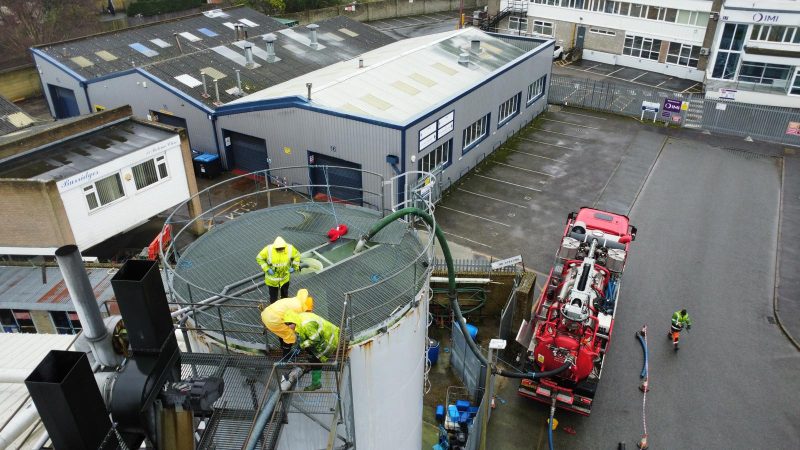
Using specialist equipment, including a lance and spinner attachment, CSG broke up and extracted the hardened material from the tower. The waste was then transferred into articulated trailers positioned opposite the site before being transported to CSG’s site in Cadishead for compliant disposal.
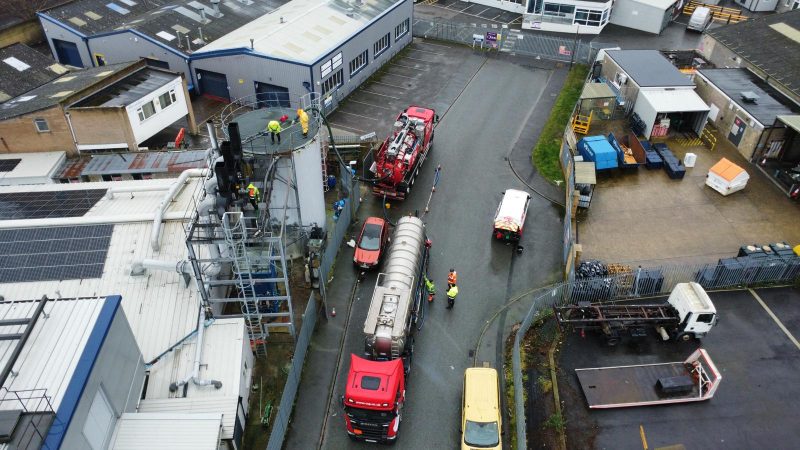
Although the original estimate suggested around 100 tonnes of material, the final amount removed was approximately 140 tonnes of hardened sludge. CSG adapted to the increased volume and ensured the project continued safely and effectively.
Once the bulk of the waste had been removed, the tank was cleaned to demolition standard. This included specialist tank cleaning from the top of the structure using a tank spinner with 360-degree movement, supported by high-pressure jetting equipment. Confined space entry was also carried out by trained operatives wearing appropriate breathing apparatus.
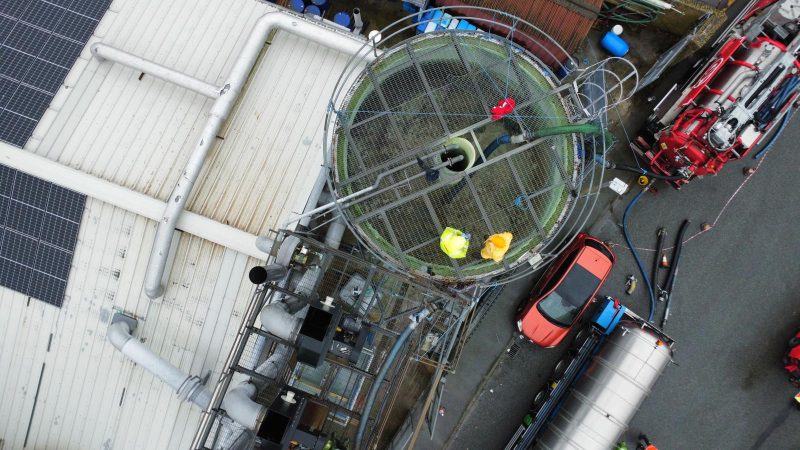
After cleaning, the tank was certified safe for decommissioning, ensuring risks had been eliminated before the next phase began.
With the tank made safe, CSG’s demolition partner, Bath Demolition, carried out the structural dismantling. Scaffolding was erected by a local contractor, and the tower was dismantled layer by layer. The metal sections were then loaded onto a flatbed vehicle and removed for recycling.
Because the hazardous waste had already been removed, this stage could be completed during the working week without the need for large-scale hazardous waste movements.
Following the removal of the structure, a CSG team returned to complete the final clearance. Remaining rubble was treated as hazardous, loaded into cut-off IBCs and removed during Twickenham Plating Group’s next scheduled hazardous waste collection.
What was the outcome?
From planning to completion, the project spanned a couple of months. However, the on-site works were completed within a highly efficient schedule:
- Two weekends for waste removal and tank cleaning
- One week for dismantling and final clearance
The project was delivered safely, on schedule and without disrupting Twickenham Plating Group’s production.
By combining hazardous waste expertise, industrial cleaning capability, confined space working and trusted specialist partners, CSG provided a complete decommissioning solution from start to finish.
The result was a safe and fully decommissioned area, with hazardous waste removed compliantly and recyclable metal recovered from the dismantled structure.
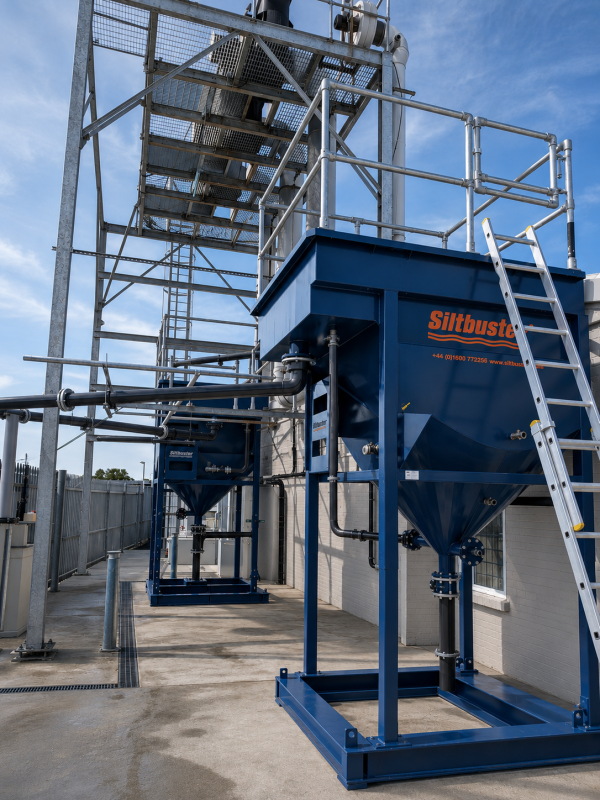
For Twickenham Plating Group, the project demonstrated how a long-standing waste management partnership can support even the most complex site requirements – helping them maintain business continuity while safely removing a major ageing asset from their operational site.
Testimonial
Here’s what Twickenham Plating’s Site Engineer John Hill had to say:
Before the settlement tower decommissioning project began, our main concerns were around safety, environmental compliance, and ensuring there was no disruption to ongoing site operations. We chose CSG because of their proven experience in hazardous waste removal and decommissioning projects, and their understanding of working safely within a live manufacturing environment.
From the outset, Sharon Thomas managed the project professionally and efficiently. She visited site during the planning stage, took the time to understand our requirements, and coordinated the works from start to finish. Sharon’s communication throughout the project was excellent, keeping us informed at every stage and ensuring any questions or concerns were dealt with promptly. Having a dedicated project manager who understood both the technical and operational requirements gave us real confidence in the process.
It was essential that production could continue while the works were being carried out, and CSG planned the project carefully to minimise disruption to both our operations and neighbouring businesses. The hazardous waste removal, tank cleaning, and decommissioning activities were completed safely, professionally, and in full compliance with all relevant requirements.
What stood out most was the organised and methodical approach taken by both Sharon and the wider CSG team. The project was delivered exactly as planned, with a strong focus on safety, communication, and customer service throughout. The final result met our expectations and left the area clean, safe, and ready for its next phase of use.
We would have no hesitation in recommending CSG to other businesses requiring hazardous waste removal, tank cleaning, or decommissioning services.